Resilience by Design: Mike Taigman’s Call for Healthier EMS Leadership
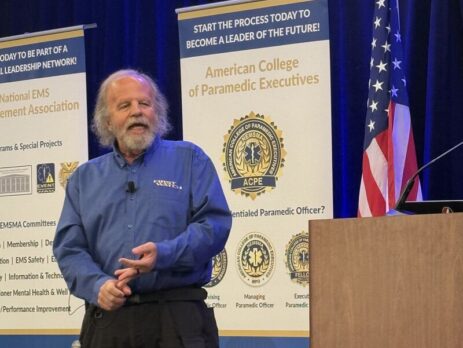
At the inaugural NEMSMA Leadership Conference in Arlington, Va., Mike Taigman delivered a session that went far beyond resilience as a buzzword. His message was both personal and practical: resilient organizations do not happen by accident. They are built by leaders who reduce fear, improve trust, model healthy habits and create cultures where people can speak up, recover and thrive.
True to form, he opened not with theory but with story and with the kind of story only EMS can produce. Recalling the only time he had found himself on the wrong side of the stretcher, Taigman described being a motorcycle crash patient while a medic prepared to needle decompress his chest for a pneumothorax he did not have. Even from the ground, injured and vulnerable, Taigman became the teacher, physically stopping the intervention and turning the moment into an impromptu lesson in assessment, judgment and staying calm under pressure.
That was more than an attention-grabbing opening. It was a neat summary of the larger point. In EMS, fire and public safety, resilience is not an abstract concept. It is practical. It lives in how we assess, how we react, how we lead and how we create the conditions in which our people either flourish or fray.
Resilience as a Strategic Opportunity
Taigman’s session was framed around resilience, but he wisely avoided reducing that word to yoga mats and motivational slogans. Instead, he connected personal health, organizational culture and leadership behavior into a single, uncomfortable truth: the way we lead can either lengthen people’s careers and health spans, or quietly help shorten them.
That was one of the strongest threads in the presentation.
He distinguished between lifespan, health span and disease span. Lifespan is simple enough, the time from birth to death. But health span is the portion of life we live before disease begins to meaningfully impair our function, while disease span is the period in which we are alive but increasingly burdened by illness. In modern America, he noted, we have managed to extend lifespan, but too often at the cost of extending disease span rather than health span.
For leaders, that matters.
The Building Blocks of True Health
Because if resilience is only discussed in emotional terms while ignoring sleep, stress, exercise, nutrition and culture, then the conversation is incomplete. Taigman made the case that much of chronic disease is not simply fate or genetics. While genetics matter, they are not the whole story. Lifestyle and environment remain enormously influential, and leaders who want resilient organizations must understand that resilience has a physical dimension as well as a psychological and operational one.
He spent considerable time unpacking that idea. Exercise, he argued, remains one of the most powerful prescriptions available, simple in concept and unlimited in refills. Get the heart rate up. Work the muscles. Do it regularly. Sleep matters too, and he pushed back on the old badge-of-honor mentality that glorifies functioning on four hours of rest. Good sleep is not weakness. It is infrastructure.
Nutrition received equal attention, and here Taigman was in full flow. He took the audience through the science and the trickery of ultra processed food, added sugar and so called natural flavorings, making the point that what is convenient, hyper-palatable and shelf-stable is often doing long-term damage. The details were sometimes startling and occasionally amusing, but the point was serious: if we want resilient people, we must stop pretending that food, sleep and movement sit outside the resilience discussion.
They are the resilience discussion.
Addressing Stress as an Agency & a Leader
Yet Taigman was far too seasoned an EMS educator to leave it there. He knows full well that public safety professionals do not burn out merely because they ate the wrong lunch. They burn out because of chronic threat stress, poor leadership, opaque systems, organizational fear and cultures that quietly grind people down.
That is where the session became especially valuable for leaders.
Taigman argued that low resilience is not just an individual problem. It is often the downstream consequence of organizational habits. Unwritten rules, fear-based management, inconsistent communication, mood-driven leadership, lack of transparency and the constant need for staff to “read the room” all create a cascading burden. Over time, that burden becomes chronic stress. Chronic stress becomes disease, disengagement, anxiety, anger, burnout and withdrawal. Eventually, organizations begin to see the symptoms everywhere: poor morale, poor documentation, short tempers, reduced initiative and people who show up physically but are no longer truly present.
In that sense, resilience is less about teaching employees to tolerate dysfunction and more about teaching leaders to stop creating it.
One of the most useful concepts he introduced was the idea of a leadership cascade effect. The way leaders care for themselves, the way they communicate, the way they handle stress and the way they relate to others all flow downhill through the organization. Leadership behavior is contagious. A depleted leader creates depletion. A fearful leader creates fear. A transparent, grounded and balanced leader creates space for others to become the same.
His challenge was simple: leaders need to take inventory of themselves first. How are you eating? Sleeping? Exercising? Connecting? Recovering? If your own cup is empty, he argued, you cannot pour into anyone else’s.
From there, he moved naturally to culture, and here he brought in Amy Edmondson’s work on psychological safety. Taigman defined it in practical terms: a workplace where people believe they can speak up without being punished or humiliated. That is not a soft concept. In public safety, it may be one of the hardest-edged operational tools available. If people do not feel safe to raise concerns, admit uncertainty, challenge bad decisions or identify brewing problems, then the organization is not resilient, it is brittle.
The distinction matters.
A resilient culture is not merely pleasant. It is one in which people are motivated, accountable and able to speak candidly. Taigman tied that directly to active bystandership, transparency and trust. Leaders who want candor must make it safe. Leaders who want engagement must make it visible that speaking up is welcome, not career-limiting.
He also offered a compelling case for transparency. Not performative transparency, but real transparency — the kind that shares the numbers, the pressures and the constraints honestly so that staff can understand the bigger picture and participate in solutions. That point clearly came from lived leadership experience, not management theory.
Conclusion
The session ended where it should have ended: with action.
Eat real food. Sleep properly. Move your body. Put the phone down and connect with people. Look for the sources of fear in your organization. Be open. Use data intelligently. Measure things that matter to patients and to the workforce. In short, build the kind of culture that helps people stay healthy, engaged and useful for the long haul.
That is what made this session land so well. Taigman did not present resilience as a personal hobby or a wellness side project. He presented it as a leadership responsibility.
At this inaugural NEMSMA conference, surrounded by leaders wrestling with staffing pressure, burnout, retention and culture, that message felt timely and necessary. Resilience is not a poster on the wall. It is not a breathing app, a slogan or a one-off seminar. It is the daily product of how we live, how we lead and what we allow our organizations to become.